Week of May 31 - June 6, 2026
Stargazers of ancient times, watching as the starry heavens turned about the world in which they lived, were convinced that the Earth was stationary and central to all. They also marveled as five wandering stars drifted among these lights of heaven from night to night, from month to month.
The Greeks called these "asters planetai" — wandering stars — and believed they might be the gods themselves, and that observing their movements through the heavens could help foretell events on Earth.
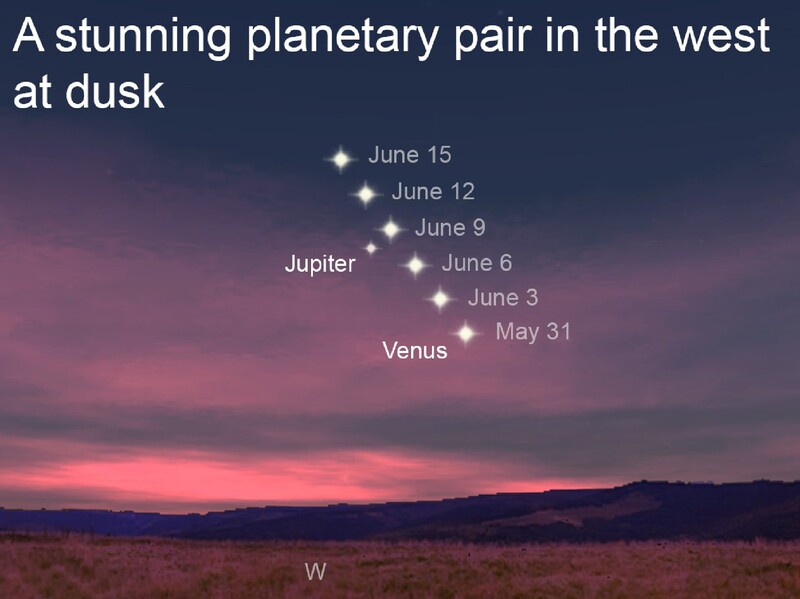
Two of these wanderers now appear in our western sky at dusk. Highest in the west after sunset is Jupiter, the king of the gods, accompanied much lower in the sky by brilliant Venus, the goddess of love and beauty.
Today, of course, we know these two bright lights as worlds of our solar system. Dazzling Venus is a planet about the same size as our own Earth and shrouded by highly reflective clouds. The fainter of the two — but still quite bright in its own right — is the giant planet Jupiter.
If you've been checking up on these two over the past few weeks, you most certainly have noticed that they appear to be approaching one another. They seem to be converging because they, along with our Earth, orbit the sun, and our constantly changing viewpoint makes them appear to drift against the more distant and "fixed" stars.
Keep watch over the next week or so, and you'll see quite a show developing in the western sky. On the evening of Tuesday, June 9, you will see that Venus and Jupiter appear at their closest — less than a degree and a half apart — and will form a bright "double star" in our western sky at dusk. This will be a great time to aim binoculars in their direction since both will appear in the same field of view.
Now, if you've got a small telescope, aim it toward each of these worlds for a stunning view. You will notice Venus in a "gibbous" phase — not quite a full disk — with a purely white, featureless disk. Jupiter, on the other hand, will display its pastel clouds stretched by its rapid rotation into parallel bands across its face, as well as three or four of its largest moons.
Though these two planets appear near each other in the sky, keep in mind that what you're seeing is an illusion. Venus and Jupiter appear to us along nearly the same line of sight but are actually quite distant from one another. This week, Venus lies about 111 million miles from Earth, while Jupiter lies about 450 million miles farther.
After June 9, the two worlds will appear to separate once again, with Venus higher in the western sky at the same time each evening. Jupiter, on the other hand, will appear lower in the sky each evening until July, when we'll lose sight of it in the glow of dusk.
What story might the ancient sky watchers have woven to explain the slow dance and rendezvous between the king of the gods and the goddess of love in the waning light of dusk?
I'll leave that to your imagination!
Visit Dennis Mammana at dennismammana.com. To read features by other Creators Syndicate writers and cartoonists, visit the Creators Syndicate website at www.creators.com.
Jupiter and Venus now appear in the western sky at dusk.






View Comments